Learn Japanese Through Images and Concepts
 admin
adminLearning vocabulary is something that language learners simply cannot avoid.
When I was a child, I used to make paper flashcards by hand. I would put small strips of paper onto a metal ring, write the word I wanted to memorize on the front, and the meaning on the back. Then I practiced them every day during my train commute to school.
Even today, if you search online, you can still find these nostalgic ring-style vocabulary cards on sites like Amazon under the stationery category.
However, they have far too many disadvantages.
First of all, you have to create every single card yourself. In many cases, people end up wasting more time making vocabulary cards than actually studying.
Secondly, audio is essential for language learning, but paper flashcards cannot provide pronunciation.
And perhaps the biggest problem is that paper flashcards cannot manage your learning progress effectively.
You cannot clearly track which words you have mastered and which words you struggle with. As a result, you end up doing a lot of inefficient and unnecessary review.
Even now, traditional paper vocabulary books continue to be published one after another. Many learners, especially from older generations, continue to rely heavily on them. Whenever a new “revolutionary” vocabulary book is released, people are tempted to buy it.
One language-learning influencer even said in one of his books that learners should practice each word at least six times.
Honestly, six times is nowhere near enough.
In paper vocabulary books, learners often put check marks next to words every time they study them, but that process itself becomes tedious and time-consuming.
You may feel productive sitting in a stylish café with a thick vocabulary book in front of you, but in reality, I do not believe that approach leads to efficient language acquisition.
Today, however, we live in an age where IT and smartphones are everywhere.
It is now entirely possible to complete your language learning using just a smartphone.
New learning apps are constantly being developed, allowing learners to study far more efficiently than before.
Among these apps, one memorization tool has continued to be used all over the world for many years:
Anki.
The word “Anki” originally comes from Japanese and roughly corresponds to the English word “memorization.”
Anki was reportedly developed around 2006 by Damien Elmes from Australia. Originally, it seems to have been used mainly for memorizing Japanese and kanji.
Its appearance is old-fashioned. It has no flashy game features.
And yet, it has continued to be used for more than 20 years.
There is a reason for that.
Anki is designed around the concept of the Ebbinghaus Forgetting Curve.
With paper flashcards, it is difficult to manage which words you remember well and which ones you frequently forget.
Anki handles that management automatically.
The Ebbinghaus Forgetting Curve is a theory that measures how quickly humans forget information after learning it.
Surprisingly, people forget around 70–80% of what they learn within one month.
That is why the idea of “practicing a word six times” is simply not enough.
Memorization goes through several stages:
Short-term memory → long-term memory → permanent retention.
During the process of turning knowledge into long-term retention, learners repeatedly forget and relearn information.
Anki is extremely powerful because it shows you review cards at the exact moment you are about to forget them.
Once your data is added into Anki, all you need to do is review your cards every day until the remaining card count reaches zero.
Words you repeatedly forget will appear every day.
Words you already know well will appear less frequently.
This makes studying extremely efficient.
Some difficult words may require not just six or seven repetitions, but 50 or even 100 repetitions.
Anki manages all of that automatically.
Anki became explosively popular between 2010 and 2015, especially among American medical students who used it for memorization-heavy studies.
Today, it is widely used not only for language learning but also for national exams and many other subjects.
This deck was created for people who want to memorize Japanese vocabulary efficiently.
Vocabulary and idioms are essential for language learning. Improving your vocabulary size is one of the keys to mastering a language.
However, what many people do not realize is that there are actually two different types of vocabulary.
Japan’s Ministry of Education explicitly distinguishes between:
- Receptive vocabulary
(words learners can understand when listening or reading)
and
- Productive vocabulary
(words learners can actively use when speaking or writing)
This distinction is extremely important.
There are countless vocabulary books designed for receptive vocabulary.
However, there are surprisingly few resources designed for productive vocabulary.
For example, Japanese students learn simple English words alongside pictures in elementary school.
Yet even many Japanese adults struggle to look at an image — a concept — and instantly produce the English word.
Most vocabulary products sold online train learners to go from “English text” to “Japanese meaning.”
But in reality, language learners should train in the opposite direction:
From concepts and images → to spoken language.
Because there are so few materials designed for this purpose, I decided to create my own.
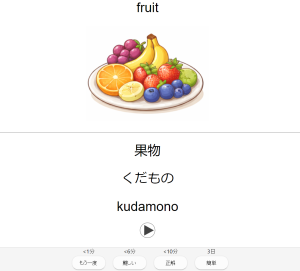
Learn 100 essential Japanese words with images and audio
Get the deck on Gumroad from the link above.
This deck introduces 100 simple Japanese words designed specifically for Japanese learners.
Learn Japanese faster with image-based learning.
✔ Perfect for beginners
✔ Visual learning with illustrations
✔ Native pronunciation included
✔ Anki deck with spaced repetition
Unlike traditional vocabulary learning, this deck focuses on speaking ability.
You do not simply memorize words.
You train yourself to instantly recall Japanese from images and concepts.
This helps you think in Japanese and speak more naturally.
By directly associating images with Japanese, you develop the “Japanese brain” necessary for fluent speaking.
Recommended for:
• Japanese beginners
• Learners who want to improve speaking ability
• Visual learners
What you will receive:
• Anki deck (.apkg file)
• 100 vocabulary cards
If there are any specific vocabulary themes or categories you would like in future decks, feel free to let me know.
Learn 100 essential Japanese words with images and audio
Get the deck on Gumroad from the link above.
\ 最新情報をチェック /